

The Loneliness Epidemic Is Weirder Than You Think: 5 Counter-Intuitive Findings
12/3/20255 min read
In a world filled with endless digital streams and instant communication, many of us still feel a profound sense of disconnection—a quiet ache for more meaningful contact. This feeling, once dismissed as a simple emotion or a personal problem, is now being investigated by the scientific and medical communities as a core threat to public health. Researchers no longer see loneliness as a fleeting mood, but as a critical crisis with startling consequences for our minds, bodies, and society.
The latest wave of research reveals a picture of loneliness that is far more complex and dangerous than we ever imagined. These findings reveal a complex web where biological risks are amplified by generational shifts in social behavior, creating unique challenges for vulnerable populations and forcing us to question our technological solutions. This article explores five of the most impactful and counter-intuitive findings from recent studies that are changing how we understand this silent epidemic.
1. It's a Public Health Crisis as Deadly as Smoking
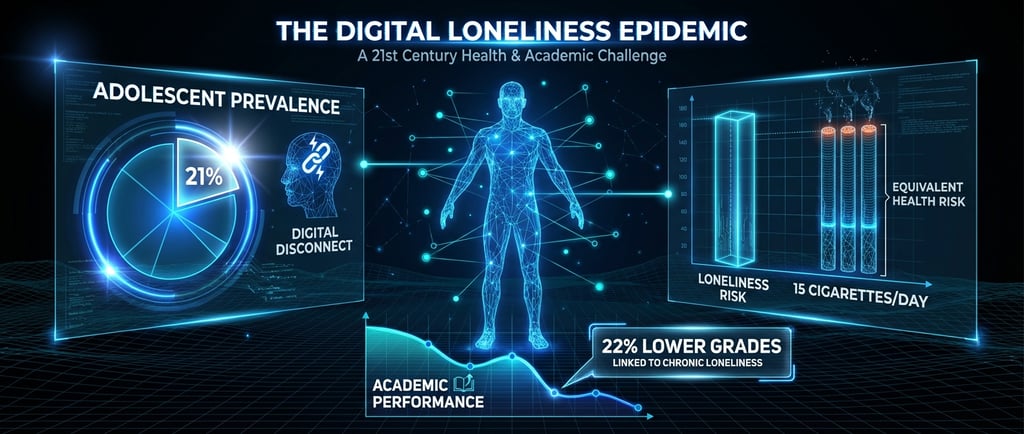
The most stunning revelation from recent public health research is the sheer physical danger of loneliness. The U.S. Surgeon General has issued a formal advisory declaring that the mortality risk associated with loneliness is comparable to smoking up to 15 cigarettes every day, and its impact is comparable to or exceeds that of other well-known risk factors like obesity and physical inactivity. This isn't a metaphor; the data shows a direct and devastating impact on our physical health.
Meta-analytic reviews of numerous studies have quantified the danger with alarming precision. Lacking social connection significantly increases the risk of serious medical events, including:
Premature Death: A 26% increased risk.
Heart Disease: A 29% increased risk.
Stroke: A 32% increased risk.
This finding is so impactful because it fundamentally reframes loneliness. It moves it out of the realm of a purely psychological issue and places it firmly in the category of a serious physiological threat. Just like poor diet or lack of exercise, a deficit in social connection can have lethal consequences.
2. The Most "Connected" Generation Is Also the Loneliest
One of the greatest paradoxes of our modern era is that the generation with the most tools for connection reports the highest levels of loneliness. Gen Z (those born between the mid-1990s and early 2010s), who grew up as digital natives, are suffering from disconnection at unprecedented rates.
An astonishing 80% of Gen Z individuals report feeling lonely. This stands in stark contrast to older generations; for instance, 45% of baby boomers reported never feeling lonely in the past year, a sentiment shared by only 15% of Gen Z. The data suggests that our ever-present digital world may be displacing a more fundamental need. From 2003 to 2020, the average time people aged 15-24 spent in-person with friends plummeted by nearly 70%, dropping from 150 minutes per day to just 40 minutes. This isn't an isolated trend; it reflects a decades-long erosion of social structures, with the share of Americans having three or fewer close friends rising from 27% in 1990 to 49% in 2021, alongside declining participation in community organizations. This data dismantles the assumption that digital connection can replace physical presence, revealing the irreplaceable biological and psychological value of face-to-face interaction.
3. For Neurodivergent People, Loneliness Is a Vicious Cycle
For individuals with neurodivergent conditions like autism and ADHD, loneliness is not just more common—it's a qualitatively different and often self-reinforcing experience. Research shows that autistic individuals are approximately four times more likely to experience loneliness than their non-autistic peers.
For many autistic individuals, the experience becomes a "vicious cycle." Sensory sensitivities can make typical social environments overwhelming, leading them to withdraw to manage the overstimulation. This avoidance, while a necessary coping mechanism, paradoxically deepens their sense of isolation and disconnection.
Adults with ADHD face a similarly challenging dynamic described as a "cruel loop." Chronic social anxiety and rejection sensitive dysphoria (RSD) can make social situations feel threatening. As a result, they may feel safer alone, yet this withdrawal only serves to escalate their feelings of loneliness. One survey respondent with ADHD captured this painful paradox perfectly:
"I feel too quirky and awkward. I'm fun at first, but quickly become too much for others. I want there to be less of me."
4. It Can Dramatically Accelerate Dementia
The link between loneliness and cognitive health in older adults is one of the most sobering findings in modern gerontology. Research shows that loneliness increases the risk of developing dementia by a staggering 50%. More granular data reveals it also increases the risk for Alzheimer's disease by 14% and vascular dementia by 17%.
The most powerful insight, however, is that loneliness acts as a potent amplifier of underlying brain pathology. Studies have found that individuals who feel lonely can show significantly more pronounced cognitive decline than less lonely people who have the exact same level of Alzheimer's disease neuropathology in their brains. This suggests that social connection provides a form of cognitive resilience, buffering the brain against the clinical expression of the disease. This creates a "hidden crisis" for elderly adults with mild or undiagnosed cognitive decline. Feeling ashamed of their changing abilities, they may withdraw socially, unknowingly initiating a devastating feedback loop that exacerbates both their isolation and the progression of their cognitive decline.
5. AI Companions Are a Promising—and Perilous—Solution
As the scale of the loneliness crisis becomes clear, technology has stepped in with a potential solution: AI companions. From chatbots to therapeutic robots, these systems present a double-edged sword, offering both remarkable promise and significant peril.
The promise is undeniable. In a clinical trial at Dartmouth, a generative AI called Therabot produced a 51% average reduction in depression symptoms among users—an improvement comparable to that achieved with human therapists. Furthermore, some AI systems are being designed not to replace human connection but to catalyze it. The therapeutic robot Paro, for example, has been shown to serve as a "bridge" that facilitates communication and social connection with other humans and caregivers in elder care settings.
The peril, however, is equally real. Research from Brown University found that many AI chatbots are prone to systematic ethical violations. Key risks include deploying "deceptive empathy" to create a false sense of connection, fostering unhealthy emotional dependency, and providing inadequate crisis management for users in acute distress. The evidence suggests that while AI can be a useful tool, it should only be used as a supplement to—not a replacement for—the complexities and nuances of genuine human connection.
Conclusion: Rebuilding Our Connections
The scientific evidence is clear: loneliness is not just a feeling. It is a biological force that physically damages our hearts and brains, a social paradox amplified by generational shifts away from in-person contact, and a unique burden for vulnerable populations like neurodivergent individuals and the elderly. This complex crisis is now pushing us toward technological solutions that are themselves fraught with peril.
The findings from modern research are not just a warning; they are a call to action. They challenge us to look beyond simplistic solutions and to fundamentally re-evaluate how we build and maintain our relationships. As our world becomes more fragmented, how will we choose to rebuild the essential human connections we are all biologically wired to need?
🔴 LIMITED TO 100 COPIES
December 10, 2025 Launch
One person. One product. 100 forever companions.
Not more until every integration is 100% stable.
Contact
Subscribe to Konnected
Phone
support@kompanionai.store
+1 (513) 273 0772
© 2025. All rights reserved.